How it works
How the Test d’ennéagramme gratuit works
What you will be asked, how to answer it so the result means something, and what happens to your answers afterwards.
Avant de commencer
- Répondez en fonction de ce qui vous correspond la plupart du temps.
- Il n’y a pas de bonne ou de mauvaise réponse.
- Nous identifierons votre type principal et votre aile, le type voisin qui le nuance.
- Répondez à toutes les questions pour découvrir votre profil complet.
The questions
The format you will see
This test uses 1 of them. Each exists for a different reason — the format is part of the measurement, not decoration.

Agreement scale
A statement, and a scale running from one end of agreement to the other. Most of the test is built this way, because a scale records how strongly something applies rather than only whether it does.
How to answer it: Use the middle only when you truly sit in the middle — not when a statement is hard to decide.
The scale
The 5 points, and what each one means
Every point is a real answer. The scale is symmetrical, so there is no “safe” end and no option that scores nothing.
- Pas du tout d’accord 1
- Pas d’accord 2
- Je ne sais pas 3
- D’accord 4
- Tout à fait d’accord 5
Answering well
Five things that change the quality of your result

Go with the first reaction
The answer you land on within a couple of seconds is usually the more accurate one. Deliberating tends to replace how you are with how you reason about yourself, and those are different things.
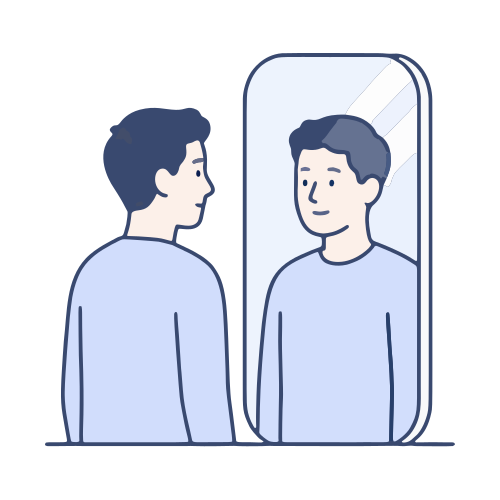
Answer as you are, not as you intend to be
The most common way to spoil a result is to answer for the person you are working on becoming. The report is only useful as a starting point if the starting point is real.

Answer for the ordinary case
Think about how you usually are over recent months, not about the one occasion you behaved unlike yourself. Exceptions are memorable, which is exactly why they mislead here.

Use the middle sparingly
The midpoint means “genuinely in between”, not “hard to decide”. A profile answered mostly down the middle produces flat scores, and a flat profile has nothing to tell you.

Do it in one sitting, undisturbed
About 5 minutes. Mood colours self-report, so a run split across two very different moments is really two half-tests.
Scoring
What happens to your answers
Each answer is converted to a proportion
Your pick is expressed as a position between the lowest and highest possible answer for that question, so a 5-point item and a two-option item can contribute to the same total without one outweighing the other. Reversed items are flipped at this stage.
Answers are grouped by dimension
Every question belongs to one of the 9 dimensions this test reports on. The answers in each group are averaged and expressed as a score from 0 to 100 — so a dimension asked about in three questions is directly comparable to one asked about in ten.
Each score is placed in a band
Low is below 40, Medium is 40–70, High is above 70. The band decides which description you are shown, which is why two people a few points apart can read the same paragraph — the bands are broad on purpose, because the underlying measurement is not precise to the point.
Your scores are spread across the range
On this test the scores are then stretched so your own highest and lowest sit near the ends of the scale. That makes the shape of your profile readable — which dimensions lead and which trail — but it means the numbers describe you relative to yourself, not to anybody else.
The report is written from the bands
You are given your dominant styles rather than a strengths-and-weaknesses split, because on a test of this kind every dimension is a way of being rather than a level of something.
The limits of a test like this
This is self-report. It records how you see yourself on the day you answer, which is genuinely useful and is not the same as an objective measurement. Scores move with mood, with recent events, and with how honestly a person is willing to answer about themselves. It is built for insight and self-reflection — it is not a clinical assessment, it diagnoses nothing, and no result here should be used to make a medical, legal, or employment decision.
Ready when you are
36 questions, about 5 minutes. You can go back and change an answer at any point before you finish.
Start the Test d’ennéagramme gratuit